Freedom on the Go: Your Guide to Portable Electric Vehicle Chargers
Jul 11,2025 | TC CHARGER
One of the biggest concerns for new and prospective EV owners is "range anxiety"—the fear of being stranded with a depleted battery. While the public charging network is expanding rapidly, there's one tool that can offer unparalleled peace of mind: the portable electric vehicle charger.
But what exactly is it, and how does it work? This guide will clear up the confusion and help you choose the right one for your needs.
What is a Portable Electric Vehicle Charger?
Let's clarify the terminology first. Technically, the "charger" is the onboard charger (OBC) inside your EV. The portable unit you carry is more accurately called portable Electric Vehicle Supply Equipment (EVSE). However, the term "portable electric vehicle charger" is universally used to describe these mobile charging cables.
There are two main types you should know about:
1. The Portable Level 1/Level 2 EVSE (Mobile Connector)
This is the most common type. It's the cable that often comes standard with a new EV.
-
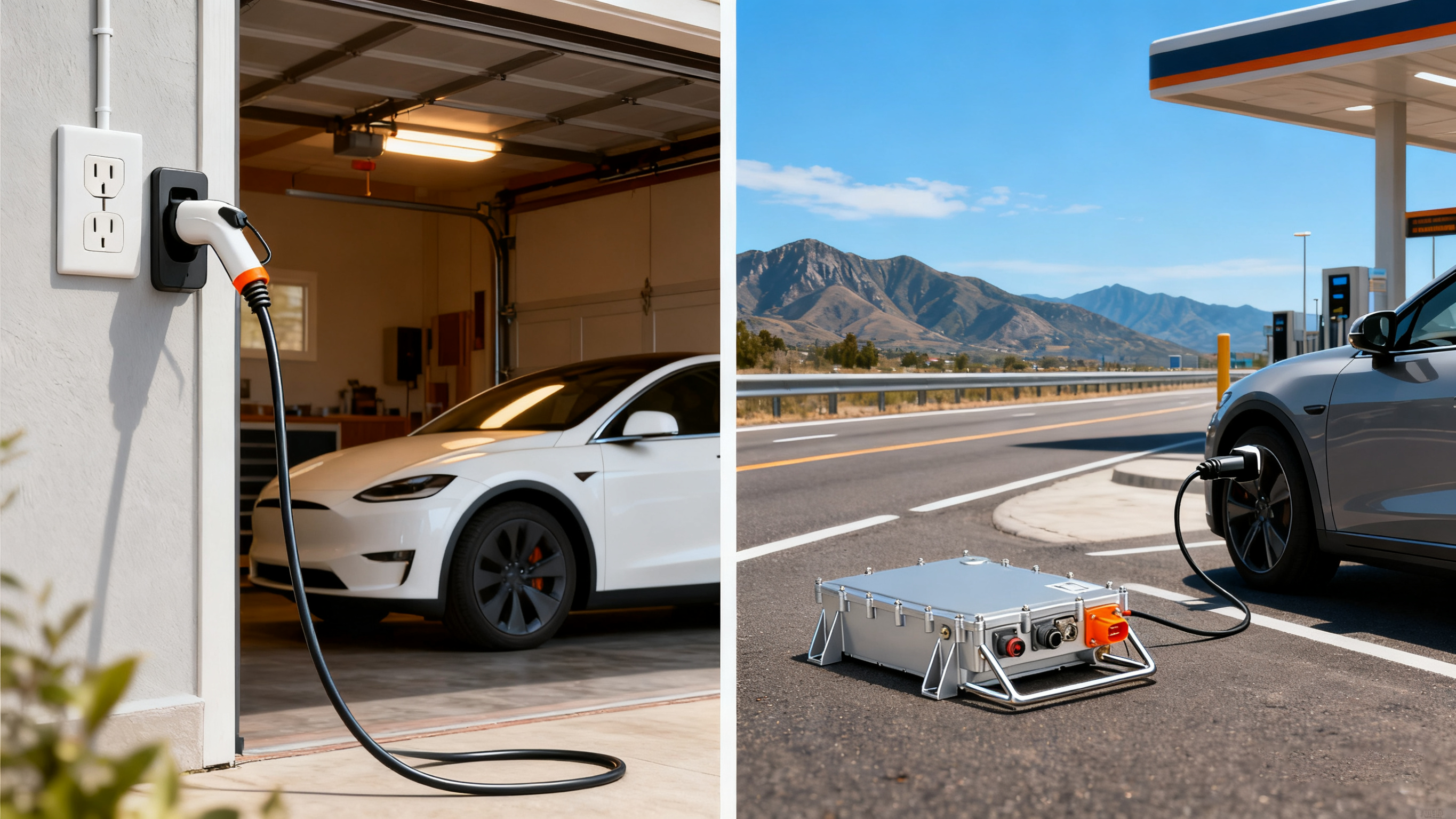
How it Works: It plugs into a standard household outlet (Level 1, 120V) or a heavier-duty outlet (Level 2, 240V, like a dryer plug) and delivers AC power to your car's onboard charger.
-
Charging Speed:
-
Level 1 (120V): Very slow. Adds about 3-5 miles of range per hour. Best for overnight top-ups or emergency use.
-
Level 2 (240V): Much faster. With a NEMA 14-50 plug, it can add about 20-30 miles of range per hour.
-
-
Key Feature: Modern versions often come with interchangeable plugs, making them versatile for different outlets.
2. The Portable DC Power Bank (EV Emergency Charger)
This is the true "power bank" for your car and represents the cutting edge of portable charging.
-
How it Works: It's a large, heavy, but movable battery pack that contains its own DC fast-charging circuitry. It connects directly to your EV's DC charging port and bypasses the onboard charger, delivering power straight to the battery.
-
Charging Speed: It's designed for emergency situations, providing just enough DC power—typically 5-10 miles of range—to get you to the next proper charging station.
-
Key Feature: Complete independence from the grid. It's the ultimate roadside assistance tool.
Key Benefits of a Portable EV Charger
-
Emergency Backup: The primary reason most people buy one. Avoid being stranded if you miscalculate your range.
-
Travel Flexibility: Charge at a friend's house, a rental property, or any location with a compatible outlet. You are no longer tethered to mapped-out charging stations.
-
Cost-Effective: A portable Level 1/2 EVSE is significantly cheaper than installing a permanent home charging station, making it a great starter solution for new EV owners.
What to Look For When Buying
If you're in the market for a portable electric vehicle charger, consider these factors:
-
Charging Speed (Amperage): A 16-amp unit will charge much slower than a 32-amp or 40-amp unit. Check what your vehicle's onboard charger can accept.
-
Interchangeable Plugs: The most versatile units come with a variety of plugs (NEMA 5-15 for standard outlets, NEMA 14-50 for dryer/RV outlets, etc.).
-
Cable Length: A longer cable (20-25 feet) provides more flexibility in how you park relative to the outlet.
-
Build Quality and Safety Certifications: Look for UL or ETL certification and a robust, weather-resistant design. Safety features like temperature monitoring and fault detection are crucial.
-
Storage Bag: A dedicated bag makes it easy to store the charger neatly in your frunk or trunk without tangles.
The Relationship with Your Onboard Charger
Remember, when using a portable Level 1/2 EVSE, you are relying entirely on your vehicle's onboard charger (OBC). The portable unit simply delivers AC power; the OBC does the hard work of converting it to DC. The speed of this process is limited by the lower of the two ratings: the output of the portable EVSE or the input of your car's OBC.
Conclusion: Is a Portable EV Charger Right for You?
For most EV owners, carrying a portable electric vehicle charger is a no-brainer. It's an inexpensive insurance policy that expands your charging options and provides significant peace of mind. Whether it's the versatile cable that comes with your car or a dedicated DC power bank for emergencies, going portable means taking control of your EV's energy needs.
Understanding the entire charging ecosystem—from portable EVSEs to the sophisticated onboard chargers inside your vehicle—is key to a great EV ownership experience. For more insights into the technology that powers electric mobility, explore the resources at OnBoard-Charger.com.
Comment