The Unsung Hero: What is an Electric Car DC DC Converter?
Sep 26,2025 | TC CHARGER
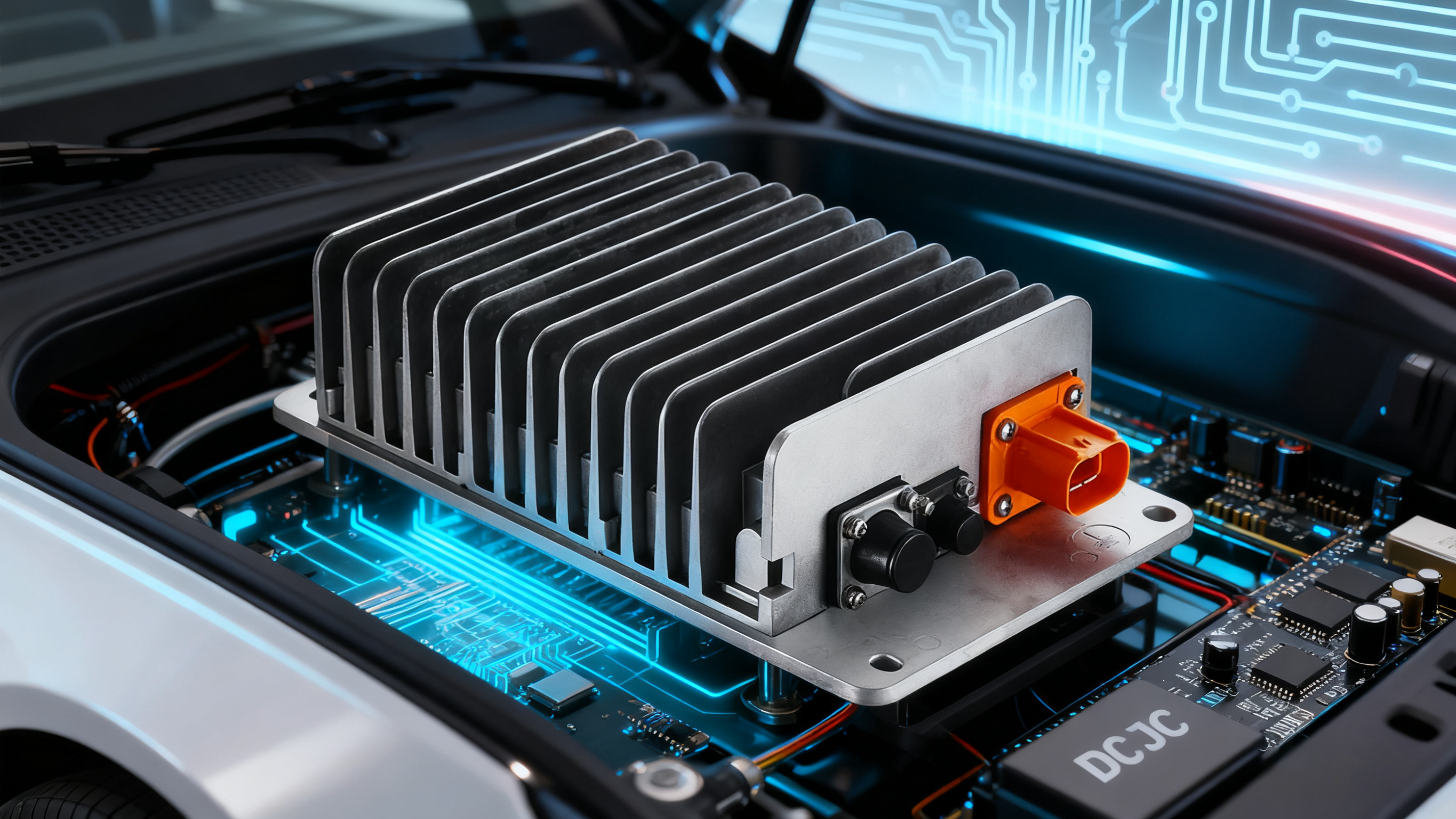
When we talk about electric vehicle (EV) powertrains, the spotlight often falls on the massive high-voltage battery and the powerful motor. But a silent, crucial component works behind the scenes: the electric car DC DC converter.
Without it, your EV wouldn't be able to power its lights, infotainment system, or even its critical computers. So, what exactly is this device, and why is it so indispensable?
The EV's Two Electrical Systems: A Tale of Two Voltages
To understand the electric car DC DC converter, you first need to know that every EV has two separate electrical systems:
-
The High-Voltage System: This is the main attraction. The traction battery (often 400V or 800V) provides power to the drive motor.
-
The Low-Voltage (12V) System: This is the familiar system found in every gasoline car. It powers everything from the headlights and windows to the wipers, audio system, and, most importantly, the vehicle's electronic control units (ECUs).
The challenge is simple: How do you power the 12V system from a 400V battery? The answer is the DC DC converter.
What Does an Electric Car DC DC Converter Do?
In essence, the DC DC converter acts as a "step-down" transformer. Its primary job is to convert the high-voltage DC power from the main battery into low-voltage (12V) DC power needed to run the auxiliary systems and keep the 12V battery charged.
Think of it as a sophisticated adapter. Just as you might use a travel adapter to plug a 120V laptop into a 240V outlet in another country, the DC DC converter safely "adapts" the high voltage from the main battery to a level the 12V system can use.
Why Can't the Systems Be Directly Connected?
A common question is: why not just use a 12V battery and be done with it? The 12V battery is still essential for:
-
Initialization: It powers up the computers that close the relays to connect the high-voltage battery when you start the car.
-
Safety: It provides power to safety-critical systems (like brakes and steering assist) even if the main battery is disconnected in an accident.
However, the 12V battery has a small capacity. Without the DC DC converter to continuously recharge it from the main battery, it would drain quickly, leaving you stranded with a "full" high-voltage battery but a dead car.
DC DC Converter vs. Onboard Charger: What's the Difference?
This is a key point of confusion. While both are essential power electronics, they perform completely different functions:
| Feature | Onboard Charger (OBC) | DC DC Converter |
|---|---|---|
| Primary Function | Converts AC (from the grid) to DC (for the main battery). | Converts High-Voltage DC (from the main battery) to Low-Voltage DC (12V). |
| When It Operates | Primarily when the vehicle is plugged into an external AC power source. | Constantly when the vehicle is "on" or in a ready state. |
| Power Direction | AC (External) → DC (Main Battery) | HV DC (Main Battery) → LV DC (12V System) |
In short, the onboard charger is for filling up the main battery, while the DC DC converter is for using the main battery's energy to power the car's everyday features.
The Importance of a Reliable DC DC Converter
A failure in the electric car DC DC converter can lead to a complete vehicle shutdown. Symptoms of a failing unit can include:
-
Warning lights on the dashboard.
-
A dead 12V battery, preventing the car from starting.
-
Malfunctions in auxiliary systems like lights or power windows.
This makes the DC DC converter a critical component for both safety and reliability. As EVs evolve, we are seeing these units become more efficient, compact, and sometimes even integrated with the onboard charger into a single unit to save space and weight.
Understanding the components that make your EV tick leads to a greater appreciation of the technology. To dive deeper into EV power electronics, from the onboard charger to the DC DC converter, explore the technical resources at OnBoard-Charger.com.
Comment